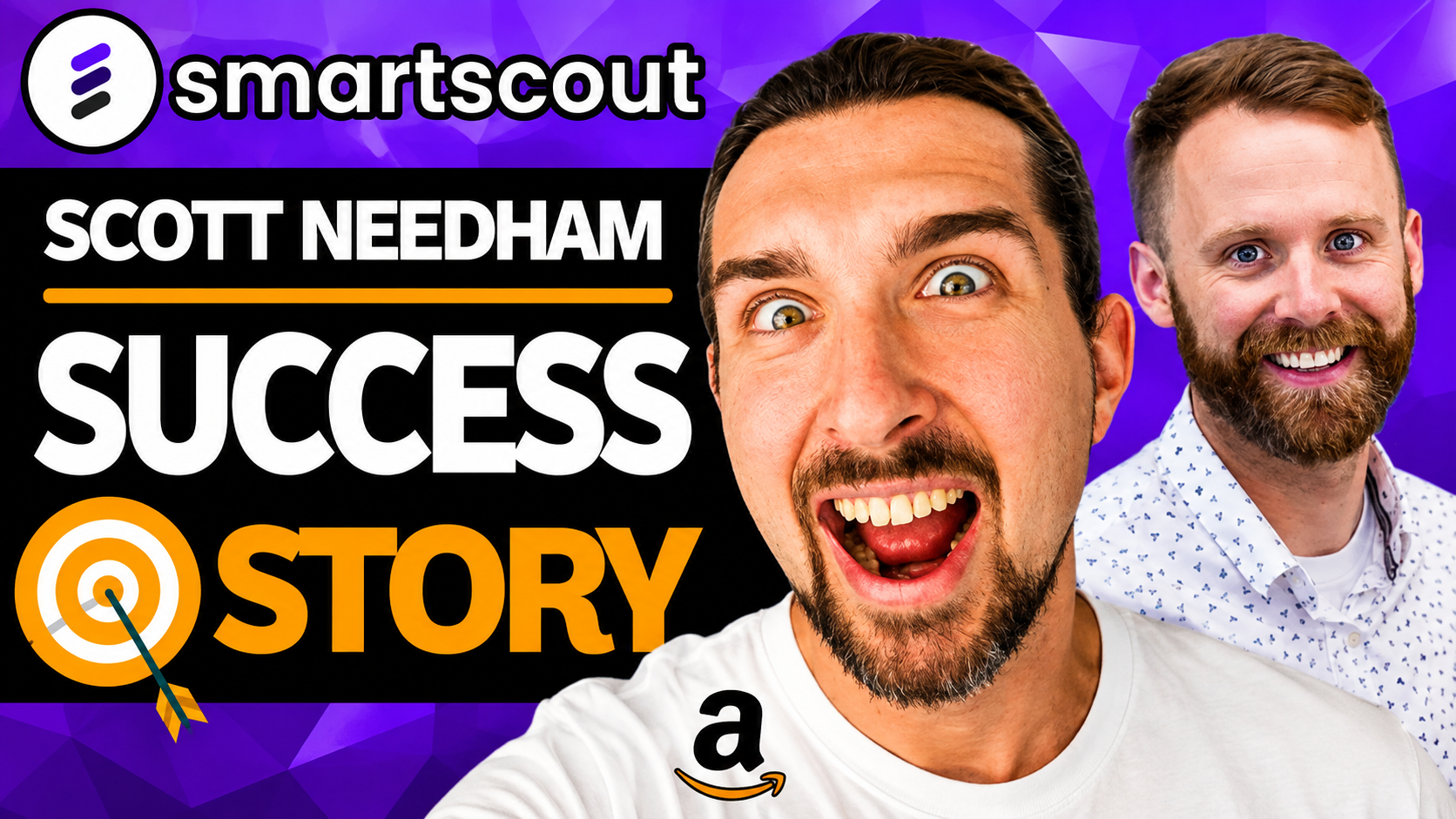
Scott Needham’s Success Story: From Amazon to SmartScout

In this guide
The quick answer
How does Scott Needham stay motivated in business?
Scott Needham, founder and CEO of SmartScout, credits continuous learning with keeping him engaged in Amazon selling and software development. In our conversation, he describes losing some drive during his second year, then gaining a wider view of what he could build. His advice is to keep educating yourself about Amazon and business beyond it.
When I asked Scott how he had kept going through years of selling on Amazon and building software, I wanted to understand the person behind the business. Beginners see an established founder and wonder how someone maintains that energy for so long.
His answer was refreshingly honest. He remembered an exciting first year, a less driven second year, and a much broader sense of possibility later on. That gives us something useful to explore: how learning can create another reason to care about the work in front of you.
Affiliate disclosure
Some links are affiliate links. If you purchase through them, I may earn a commission at no extra cost to you. Read my full disclosure.
Why Scott’s second year felt different from his first
Scott describes his first year as a period of intense involvement. He was working on improvements throughout the business, and the effort felt meaningful. There were things to understand, processes to improve, and visible ways to contribute.
In his second year, that feeling changed. He says he became less motivated because he was no longer making the same kind of impact. The work did not feel as transformative. He places that period in 2014 while reflecting on it during our interview.
To me, his answer shows how a sense of progress can change as the work develops. He had once felt deeply involved in improving everything. Later, he felt less impactful. That makes the question of what to learn next a useful part of the discussion.
Looking back, he wishes he had understood how much more there was to learn. He could see possibilities later that had been much harder to recognize during that second year. That hindsight is the useful part of his story for someone feeling stuck today.
My takeaway is to examine the work when your enthusiasm fades. Which problems have become routine? Which questions are you avoiding because you do not yet know how to answer them? Those questions can help you identify a skill worth developing next.
A useful place to start is your list of unfinished decisions. You might be postponing a supplier comparison, repeating an unclear handoff, or struggling to interpret a research report. Pick the issue that has a clear consequence for your work. That gives curiosity a direction and makes the learning easier to apply.
SmartScout offer
SmartScout: 25% off your first three months
My advertised SmartScout offer uses coupon code VOVA25 for 25% off your first three months. Open the discount page and check the eligible plan, applied discount, billing period, and renewal price before subscribing.
How continuous learning renewed his sense of possibility
Scott explains that the years leading up to our conversation had brought a tremendous amount of learning. He could see exciting work ahead in both his Amazon business and his software business. His understanding of what was possible had expanded.
He also broadens the subject beyond the Amazon seller community. There was more to learn about business itself. That is a valuable distinction because a seller’s next useful lesson might involve communication, organizing work, understanding customers, or helping a team make better decisions.
I would apply that idea by choosing a topic connected to a real difficulty. If supplier conversations keep going nowhere, study how to prepare clearer questions. If the same operational mistake keeps returning, learn how to document the process. Give the learning a job to do.
Scott’s central message is simple enough to remember: keep learning. The practical challenge is deciding what deserves your attention now. You can make that easier by starting with one question from your own business and looking for knowledge that helps you answer it.
Before adopting an idea, ask which business model it assumes. Advice for wholesale sourcing may answer a different question from advice for building a private label brand. Note the marketplace, resources, and stage of business in the example. That context helps you decide what to investigate and what to leave for later.
01
Find the gap
Name one task that feels confusing or repeatedly slows you down. Make the problem specific enough to study.
02
Learn with purpose
Choose a relevant tutorial, conversation, or example. Write down what it changes about your understanding.
03
Put it to work
Apply one idea and review what happened. Keep a short note so the next attempt starts with more context.
How Scott’s Amazon experience connects to SmartScout
During the interview, Scott connects his renewed drive with building SmartScout and continuing to run several businesses. He describes having plenty of exciting work to do. Learning had given him more areas to explore and more problems he wanted to solve.
The official SmartScout company story adds useful background: the platform grew from systems Scott and the BuyBoxer team used to analyze Amazon markets, brands, and competitors. That connects the software to practical questions arising inside an Amazon selling operation.
Today, SmartScout describes its role as Amazon market intelligence for sellers, brands, and agencies. Its tools cover areas such as product research, brand research, and competitor analysis. Those capabilities give context to the company Scott discusses, while the interview itself focuses on his motivation.
For me, the transferable lesson is to notice recurring problems in your own work. A better process or clearer research method may begin with a question you keep asking. You can improve that small part of the business without knowing where the idea will eventually lead.
For your own business, start by listing the questions that repeatedly take time to answer. Which competitor should you investigate? What information is missing before you contact a brand? A tool becomes easier to assess once you know the output you need. That gives a software demonstration a clear purpose.
If you want to connect the founder’s story with the product, my SmartScout product research tutorial walks through how the software is used.
Why I listen to sellers who are further ahead
Near the end of the conversation, I explain why I value hearing from people with more experience. At the time, our brand had about ten products, and the work still felt challenging. I could enjoy the business while also having plenty of questions about it.
That is why I asked Scott how he kept going. Hearing someone describe their less productive periods adds context that a polished success story can leave out. It helps me understand the choices and changes behind the outcome I can see.
When you listen to an experienced seller, try asking about the problem they faced, what they learned, and what they changed afterward. Their answer becomes easier to evaluate when you understand the circumstances. A tactic from a large operation may need adapting to a smaller business.
I also like asking what someone would learn earlier if they could start again. Scott’s answer points toward a wider business education. That question can help you discover a useful topic before spending months repeating an approach you have never properly examined.
A helpful follow-up is to ask how they knew an improvement was working. Listen for the evidence they used and the uncertainties they still faced. You can then consider whether you have comparable information. This keeps the conversation grounded in decisions you can understand and discuss with your own team.
If you speak with several sellers, compare where their advice agrees and where their circumstances differ. Those differences can become research questions of their own, especially when you are choosing between two possible approaches.
A practical weekly learning plan for Amazon sellers
Here is my suggested way to apply the conversation. This is a practical exercise inspired by Scott’s message, rather than a routine he describes in the interview. Keep the scope small enough to complete alongside your normal work.
| Step | What to do | What to keep |
|---|---|---|
| Choose | Pick one recurring question from your business. | A clear sentence describing the problem. |
| Study | Use one relevant source and take focused notes. | An idea you can explain in your own words. |
| Apply | Try a manageable change in a defined task. | A record of what you changed and why. |
| Review | Compare what happened with your expectation. | A decision about the next attempt. |
For example, imagine you keep collecting product ideas but cannot explain why one deserves further research. Your learning task could be to define comparison criteria. Watch a relevant demonstration, choose a few comparable products, and write down the same observations for each.
At the review, ask whether the comparison made your next decision clearer. Perhaps it revealed missing information. Perhaps you realized the products served different customers and needed separate comparisons. Either result gives you a more precise question for the next session.
As you work through the exercise, record what became clearer and what still needs checking. Include the question you started with and the action you took. This gives your next learning session a practical starting point and a reason to stay focused.
Set the review date before you begin, and decide what you can reasonably observe by then. For a research task, that might be a clearer shortlist or a missing detail you have now identified. For a process change, it might be whether another person can follow your instructions. Keep the goal close to the task so you can assess it fairly.
Open your weekly reflection prompts
- What do I understand better than last week?
- Which assumption still needs evidence?
- What is the smallest useful next step?
SmartScout offer
Bring a clear research question to SmartScout
Considering the software? Use VOVA25 for the advertised 25% off your first three months. Compare the SmartScout plans and features, choose the access your task needs, and confirm the offer and ongoing price at checkout.
Questions about Scott Needham and SmartScout
Who is Scott Needham?
Scott Needham is the founder and CEO of SmartScout. His background includes building systems for Amazon selling, and SmartScout’s official company history connects the platform to the research needs of the BuyBoxer team.
What does Scott say kept him going?
He credits continued education and learning. In the interview, he explains that discovering more about Amazon and business opened up exciting work and helped sustain his interest in building companies.
Did Scott always feel motivated?
No. He describes an energetic first year and a less driven second year, when he felt he was making less impact. He later wished he had recognized more of the possibilities available to him.
Does this interview explain how to use SmartScout?
This short conversation focuses on Scott’s mindset and experience. For a demonstration of the research tools, follow the SmartScout tutorial linked above and choose a task relevant to your business.
Choose the next skill your business needs
What stayed with me from this conversation was Scott’s willingness to revisit his own assumptions. He could look back at a period of lower motivation and recognize how much more there had been to discover.
Choose one business question you want to understand better this week. Find a useful source, apply one idea, and give yourself time to review it. That is a practical way to bring his advice into your own Amazon journey.
If you have a question after watching, share what you are trying to understand in the video comments. Include the situation behind it so the discussion can move toward a useful answer for you and other sellers.
Vova :)
More to explore