Why I Love Selling on Amazon FBA: My Journey & Lessons

In this guide
The quick answer
Why am I passionate about selling on Amazon FBA?
I love Amazon FBA because it gave me the chance to build a business around my life rather than arrange my whole life around a job. I value the freedom to work from different places, choose my schedule, create private-label products, and keep learning. It has also brought hard lessons. Freedom is something you build through work, good systems, and patience—not something Amazon hands you on day one.
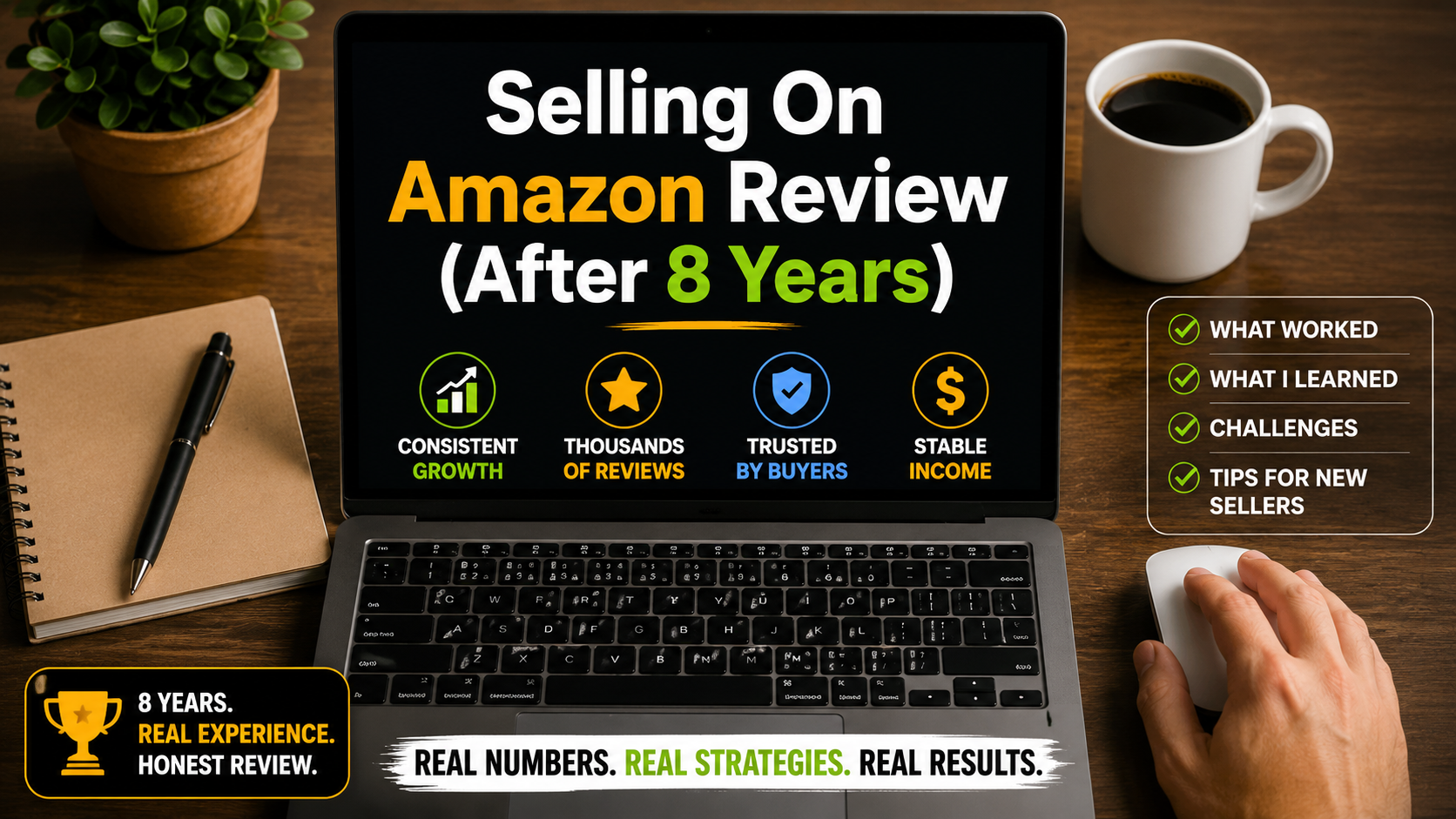
I started selling on Amazon in 2016. In the video behind this article, I share how the business grew to several million dollars in product sales, why I kept going, and what helped me move from having a regular job toward full-time entrepreneurship. Those sales figures describe products sold over time, not personal profit or guaranteed earnings.
My friends at Helium 10 challenged me to explain why I am so passionate about the Amazon business. I accepted because I remember what it feels like to be at the beginning, wondering whether a different way of working is even possible.
My experience has inspiring moments and difficult ones. Take what helps, and adapt it to your own goals.
Affiliate disclosure
Some links in this article are affiliate links. If you sign up or purchase through them, I may earn a commission at no extra cost to you. This helps me keep my videos and guides free. Read the full disclosure.
The first reason: location freedom
One of the biggest reasons I fell in love with selling on Amazon is the ability to work without being tied to one location. At the time I recorded this video, I had been traveling around the world for about two years while running my Amazon FBA business, YouTube channel, and educational projects.
What made that possible? Much of the business could be coordinated online. We sold products in the United States even though I had never visited the country at that point. We sourced from China without my having traveled there. We were also selling in Canada for years before I made my first visit.
I still find that amazing. You can communicate with a supplier, review a product design, check inventory, and talk to your team without standing in the same room. Amazon's fulfillment system can handle important parts of storage, packing, shipping, and customer delivery for eligible FBA orders.
But remote work is not responsibility-free. You still manage product quality, inventory, listings, returns, and legal requirements.
What location freedom means to me: I can build processes that let me manage the business from different places. It does not mean the business runs itself or that every seller can travel whenever they want.
The second reason: more control over my time
Location is only part of the story. I also wanted the ability to decide when I worked. That may sound simple, but it took time to reach a point where my business did not need my attention every minute of the day.
In the beginning, founders often do everything: research products, email suppliers, organize shipments, improve listings, and answer questions. You might spend more hours working on your own business than you did at your old job. I would never describe those early stages as an instant escape from work.
The opportunity appears when you learn how to systemize repeatable tasks. Write clear instructions, track what matters, build a dependable team when your budget allows it, and keep decisions organized. Then you can focus more of your energy on the work that truly needs you.
That is the kind of time freedom I enjoy: more choice, fewer unnecessary interruptions, and room for the rest of life. It is earned gradually through better habits, not unlocked by opening an Amazon seller account.
The third reason: private label lets me create something
I have a creative side, and Amazon private-label selling gives it a practical outlet. Instead of only reselling someone else's branded product, I can work on the idea, design, presentation, and story of a product sold under my own label.
In the video, I show artwork that my friends and I created. I enjoy that same process of making something my own when I work on a product and its brand.
Of course, a good-looking logo is not enough. A private-label brand still needs to solve a real customer problem, meet safety and quality requirements, and make financial sense. I would rather sell something genuinely useful with simple packaging than a beautiful product that disappoints buyers.
If that creative side interests you, my Amazon private-label beginner's guide walks through the steps, from researching a product to working with suppliers and creating a listing.
Free account and seller tools
Explore Helium 10 with my discounts
I use Helium 10 as an Amazon seller, and I share my affiliate offer with viewers who want to explore it. Start with the limited free account, then consider paid tools only if they fit the work you need to do.
VOVA10
10% off
Recurring discount on an eligible paid subscription.
VOVA6M20
20% off
First six months on an eligible paid subscription.
Get free Helium 10 access and offers
Discount availability depends on the plan, billing period, and account. Check the final price and renewal terms before paying.
What helped me make progress? Continuous learning
Passion got me interested, but learning helped me stay in business. Amazon changes. Customer expectations change. Advertising methods change. A tactic that worked a year ago may be less useful now.
I try to keep learning about Amazon itself and everything around the business. I listen to other sellers, speak with people who have different experiences, and join mastermind discussions. I also learn from mistakes—mine and other people's—because mistakes can be expensive when they involve inventory.
Connecting with good people helps. Sometimes one useful conversation reveals a problem you would otherwise miss.
Watching tutorials is not enough; apply each useful lesson and check the result.
Learn
Ask sellers, study a specific problem, and find reliable guidance.
Apply
Try one sensible improvement with a clear goal and a manageable risk.
Review
See what changed, write down the lesson, and adjust your next step.
If product research is the skill you are improving, start with my Amazon product research tips. They can help you move from collecting ideas to checking whether an idea deserves more work.
I wanted more than a side hustle
When I began, one of my strongest motivations was becoming a full-time entrepreneur. I wanted to leave my job and make my living through a business I had built. That goal made me take the work seriously, even during periods when the exciting parts were harder to see.
In the video, I explain that I reached a point where I could quit my job and felt financially comfortable. I was grateful to provide for my family and to help people in need. Being able to give something back made the work more meaningful.
"Rich" means different things to different people. For someone else, success may mean more time with family or less stress.
My story is one example of what entrepreneurship can make possible, not a forecast for a new seller. A business that generates millions in sales may also have large costs. Profit depends on what remains after inventory, Amazon fees, shipping, advertising, refunds, and other expenses.
Why sharing what I learn matters too
I began creating Amazon education content on YouTube in 2018, after starting my selling journey in 2016. I enjoy explaining what I have learned because another seller may be facing the same question I once struggled with.
My goal is to make useful tutorials and guides available without a paywall. The affiliate relationships help support that work. When someone chooses a tool through one of my links, I may earn a commission, while the reader can still compare options and decide whether to purchase.
I want tutorials to clarify decisions, not make people believe that buying software guarantees sales.
There is plenty more to explore in my complete Helium 10 tutorial guide, which connects research, keywords, listings, and business operations.
Free video lessons
Browse my Amazon selling and Helium 10 video collections. The original video points to more than 200 tutorials.
Explore my YouTube tutorialsFree listing course
Prefer a focused lesson? This video playlist covers Amazon listing optimization with Helium 10.
Watch the free courseWhat I would tell someone thinking of starting Amazon FBA
First, be curious, but do not confuse motivation with a business plan. Before spending money, learn how FBA works, compare selling models, and ask what risks you can realistically afford to take.
- Learn the basics. Understand Amazon's fees, fulfillment process, selling requirements, and the costs of keeping products in stock.
- Choose a model that fits. Private label suits people interested in brands and product development, but it is not the only way to sell on Amazon.
- Study customers before suppliers. Look for needs you can meet, then research competitors, quality, pricing, and demand.
- Test your numbers. Estimate inventory costs, shipping, platform fees, advertising, returns, and cash needed for reorders.
- Build useful relationships. Find reliable suppliers, learn from other sellers, and ask for help when a decision is outside your expertise.
- Keep improving. Treat the first product or project as the beginning of a learning process, not a final judgment on your potential.
Use free guides first, and choose a budget before paying for tools or courses.
If you want a structured course, my Freedom Ticket guide explains the training. The current Helium 10 policy includes full course access with qualifying paid subscriptions beginning at Platinum; a free account alone does not unlock the complete course.
Explore the Freedom Ticket course and pricing
In the video's description, I linked Freedom Ticket as a learning option. Helium 10 lists standalone course access at $997, while eligible paid subscribers receive access as part of their subscription. Check today's entitlement and terms before enrolling.
Check Helium 10's official Freedom Ticket access policy for the current eligibility details.
The biggest lesson: give passion time to grow
I do not think everybody has to wake up already in love with the business they eventually build. Sometimes passion grows because you learn a skill, solve a problem, and see that your work can help somebody.
Quitting can be the right move. But if you regularly abandon new projects before giving them a fair chance, ask whether your goals, expectations, or plan need attention.
A difficult month does not mean you have failed. But do not ignore financial warnings just to prove you can persevere.
For me, the deeper reward has been the chance to keep growing, meet helpful people, support my family, and share useful lessons. Amazon selling is one part of that story. The larger goal is building a life that feels meaningful to you.
Amazon FBA motivation: common questions
Can Amazon FBA give you location freedom?
It can make remote management possible, especially when fulfillment and business operations are organized well. You still need to oversee suppliers, compliance, inventory, finances, and customer issues. Freedom grows with reliable systems.
Is selling on Amazon a passive income business?
Not in the sense of doing nothing. FBA takes on certain fulfillment tasks, but product selection, replenishment, quality, advertising, fees, and planning still require attention. Work can be delegated or organized, not simply wished away.
Do you need Helium 10 to start?
No. Research software can help you compare products and keywords, but your business still depends on useful products, sound costs, customer understanding, and execution. Start with the free resources that answer your next question.
One more helpful resource
Learn, practice, and choose the tools that fit
You can explore Helium 10 with a limited free account or compare eligible discounts if a paid plan makes sense. My codes are VOVA10 for 10% recurring savings and VOVA6M20 for 20% off the first six months, subject to checkout eligibility.
Check my Helium 10 free account and discounts
Paid tools are optional. Compare benefits, limits, and renewal costs before buying.
Whatever stage you are at, I hope this story encourages you to keep learning, connect with good people, and find work that gives you room to grow. Keep going when it makes sense, change course when the evidence calls for it, and remember why you started. Wishing you a great life. :)